


 ไทย
ไทย ENG
ENG 中文(简体)
ความรู้จากแพทย์ศรีพัฒน์
What is Cardiac Rehabilitation?
Dr.Chanadda Wongekchutrakul
Rehabilitaion Medicine
PI-IMC-025 (E) Rev.00
Date 30/04/2025
What is Cardiac Rehabilitation?
Cardiac rehabilitation is a structured exercise program designed to help heart disease patients return to their daily activities and achieve a quality of life similar to their pre-illness state, both physically and mentally. It aims to reduce symptoms such as fatigue and shortness of breath. The program not only focuses on the heart condition but also addresses individual risk factors associated with individual patient.
Benefits of Cardiac Rehabilitation
- 1. Reduces Mortality and Hospitalization Rates: Helps decrease the death rate and the frequency of hospital stays for heart disease patients, alleviating symptoms like fatigue and chest pain.
- 2. Enhances Physical Activity: Improves the ability to perform daily activities and exercise, and increases the capacity to return to work.
- 3. Increases Knowledge and Understanding: Educates patients about heart disease, leading to better quality of life and effective management of cardiovascular risk factors.
Who Should Undergo Cardiac Rehabilitation?
- 1. Patients with Ischemic Heart Disease: Including those who have undergone balloon angioplasty and stent placement.
- 2. Heart Failure Patients: Those without exacerbated symptoms.
- 3. Post-Heart Surgery Patients: Such as those who have had valve surgery or coronary artery bypass grafting.
- 4. Individuals at Risk of Cardiovascular Disease: Including those with diabetes, hypertension, hyperlipidemia, and obesity.
Inpatient Cardiac Rehabilitation Program at SRIPHAT medical center
The cardiac rehabilitation program includes exercise training to strengthen the body and heart function, health education focusing on individual risk factor management, and stress management. The program progresses at a pace suited to the patient’s condition and symptoms, under the supervision of a multidisciplinary team comprising cardiac surgeon, cardiologists, rehabilitation physicians, nurses, physical therapists, pharmacists, and dietitians.
Calisthenic Exercises
Why Calisthenic Exercises?
Calisthenic exercises are suitable for cardiac rehabilitation as they involve no resistance and start with low energy expenditure, gradually increasing based on the patient’s condition and symptoms.
How to Perform Calisthenic Exercises
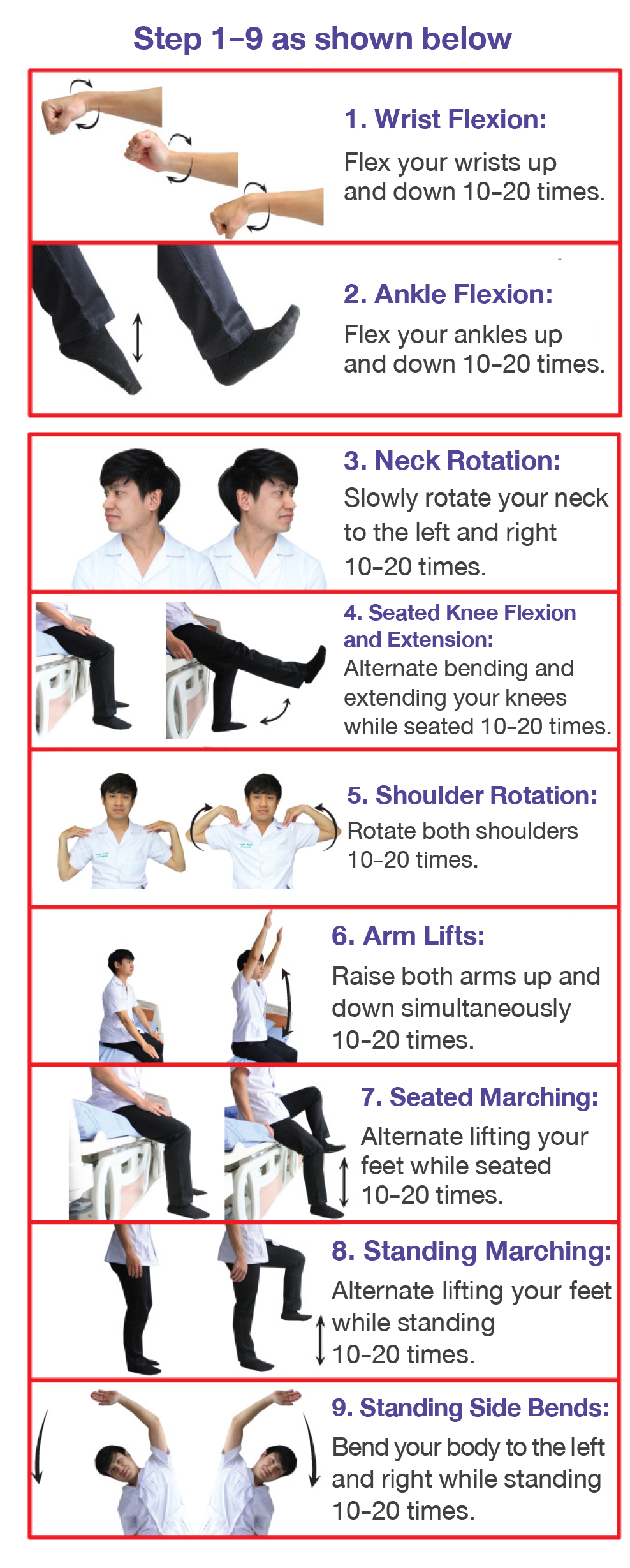
Begin with a warm-up by performing exercises from step 1 to 9, and cool down by reversing the order from step 9 to 1, or follow the cardiac rehabilitation team’s guidance. During exercise, maintain continuous movement, avoid holding your breath, and do not tense up.
When to Avoid Exercise
Patients should refrain from exercising if they experience:
- 1. Chest pain similar to ischemic heart disease or exacerbated heart failure symptoms.
- 2. Acute illness such as high fever, severe dizziness, headache, fainting, or extreme fatigue.
- 3. Extreme weather conditions or high levels of dust, smoke, or exhaust fumes.
- 4. Heart rate exceeding 120 beats per minute or blood pressure over 180/110 mmHg.
- 5. Blood sugar levels below 100 mg/dL or above 300 mg/dL in diabetic patients.
Home Exercise Recommendations: Post-Hospital Discharge
Type of Exercise: Various forms similar to those performed in the hospital can be used, but walking is the most recommended. Follow the doctor’s instructions strictly and aim to walk for the prescribed duration.
Steps for Walking Exercise
- 1.Warm-Up Phase: Perform calisthenic exercises from step 1 to 9 slowly and continuously, avoiding any tension. Each step should be repeated 10-20 times, taking approximately 10 minutes.
- 2. Exercise Phase: Follow the schedule by hospital-discharge duration:
- - Week 1: Walk at your normal pace for 5 minutes, aiming for a level of exertion similar to that experienced in the hospital before discharge.
- - Week 2: Continue as in Week 1, but increase the walking duration to 10 minutes.
- - Week 3: Continue as in Week 1, but increase the walking duration to 15 minutes.
- - Week 4: Continue as in Week 1, but increase the walking duration to 20 minutes.
- - Week 5: Continue as in Week 1, but increase the walking duration to 30 minutes.
- - Subsequent Weeks: After reaching 30 minutes, try to walk faster to increase the distance covered, while maintaining the 30-minute duration.
3. Cool-Down Phase: After exercising, do not stop abruptly. Perform calisthenic exercises from step 9 to 1, repeating each position 10-20 times, for about 5-10 minutes.
Slow Down Exercise If You Experience:
- 1. Unusual fatigue.
- 2. Shortness of breath or difficulty speaking.
- 3. Chest pain.
- 4. Muscle or joint pain, or cramps.
Indications to Stop Exercising:
- 1. Chest pain, dizziness, nausea.
- 2. Extreme fatigue, shortness of breath.
- 3. Muscle pain.
- 4. Excessive sweating.
- 5. Heart rate exceeding the maximum prescribed by your doctor.
- 6. Systolic blood pressure drops more than 10 mmHg from resting level.
- 7. Diastolic blood pressure exceeds 110 mmHg.
Exercise in heart disease patients carries high risks, so it is crucial to follow the advice of your doctor and the cardiac rehabilitation team strictly.